Your team spends hours every week assembling the same reports, pulling together client updates, and preparing board packs. The work is essential but repetitive—and it drains time from higher-value activities. Mid-market B2B leaders face a constant challenge: teams bogged down by these high-stakes tasks, leaving little room for strategic work.
You've likely experimented with AI tools. Perhaps a few team members use ChatGPT for drafting, or someone built a prompt library. But these ad-hoc approaches create their own problems: inconsistent outputs, version confusion, and results you can't fully explain to stakeholders or auditors.
The hype around AI agents promises a solution: autonomous systems that handle complex tasks end-to-end, deciding their own approach as they go. But can agentic AI actually run your business processes? The honest answer is not yet—at least not for work where consistency, auditability, and accuracy matter. Agents excel at exploratory tasks like research and coding, but they introduce unpredictability that creates real liability when you need to defend your methodology to a board, auditor, or regulator.
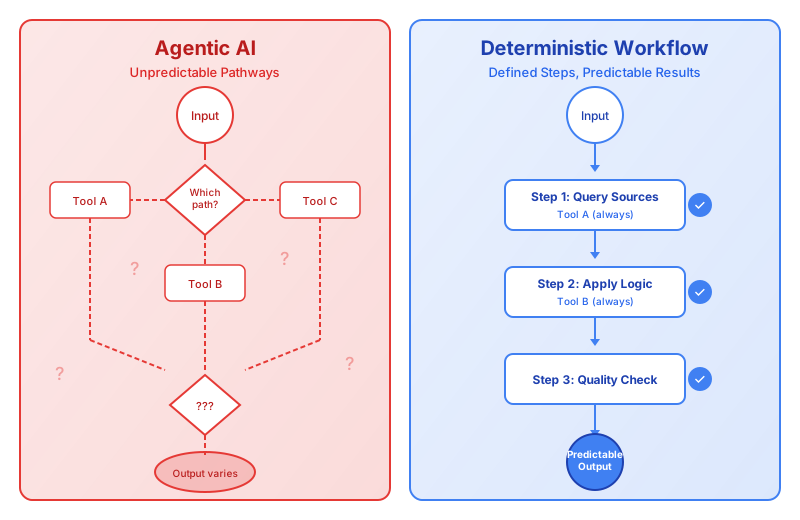
This is where deterministic AI workflows change the equation. Unlike AI chat tools where each conversation takes an unpredictable path, deterministic AI workflows follow defined steps—pulling data from established sources, applying consistent logic, and producing results you can compare and refine. The process is the constant, not the output. This reliability is why enterprises increasingly favor deterministic approaches for production systems.
If you're exploring how AI can transform the way your team works—but worried about the risks of turning critical processes over to unpredictable systems—deterministic AI workflows offer something rare: the productivity gains of automation with the predictability your business requires. With Clear Ideas, cited provenance and automated quality checks for readability, accuracy, clarity, and tone make outputs easier to verify and trust.
The value is tangible: 70-90% reductions in manual processing time and 10x faster analysis for tasks like due diligence and contract review. This article examines how deterministic AI workflows deliver more reliable, reviewable outputs and outlines practical implementation steps for your organization.
Why Deterministic AI Delivers Reliable, Reviewable Results
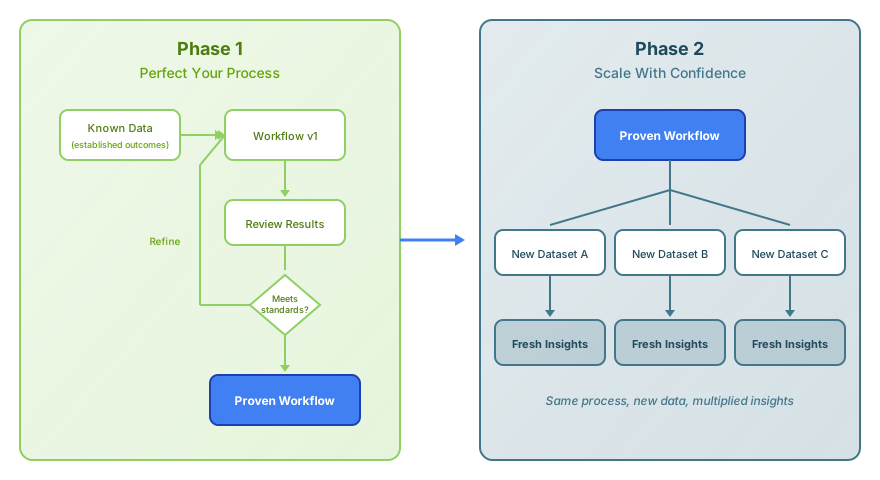
So what does this look like in practice? The difference comes down to control. With deterministic workflows, every run follows the same defined steps—same data sources queried, same analysis logic applied, same quality checks performed. You can validate the process on known data, confirm it produces what you expect, and then apply that proven methodology to new datasets with confidence.
In compliance-heavy B2B settings like virtual data rooms and due diligence reviews, this control is essential. You need to be able to perfect your process over time, compare results across datasets on equal footing, and clearly explain your methodology to auditors and regulators.
The Risks of Non-Deterministic AI in High-Stakes Settings
When teams use AI through ad-hoc prompts without structured workflows, the risks compound. There's no systematic way to verify outputs against source documents, no consistent quality checks, and no audit trail showing how conclusions were reached. Each interaction is a one-off—making it difficult to catch errors before they reach stakeholders or to demonstrate a defensible process after the fact. Reports note that scaling AI demands extensive process redesign and data cleanup.
In due diligence or contract reviews, small errors risk compliance issues or lost deals. More than 65% of organizations cite lack of accuracy and 40% cite lack of explainability as a significant risk to AI adoption—ranking higher than cost or technical challenges, according to Stanford's 2025 AI Index Report. Surveys show 78% of executives view agentic AI as requiring new operating models.
When a CEO needs to defend a financial analysis to the board, or a deal team must demonstrate due diligence to regulators, "the AI suggested it" isn't an acceptable answer. They need to show exactly how conclusions were reached and which source documents informed them, and the process followed to arrive at the conclusions.
What Makes Deterministic AI Workflows Reliable
Deterministic AI workflows follow a defined sequence of steps: data sources queried, the same analysis applied, the same quality checks performed.
Think of it this way: deterministic workflows follow a strict playbook. You can perfect that playbook on known data with established outcomes, validating that each step produces what you expect. Then you apply the same proven process to new data, gaining fresh insights through a methodology you trust.
This is fundamentally different from agentic AI approaches where the system decides its own path. With deterministic workflows, you control the journey—which sources to query, what logic to apply, how to structure outputs. The AI executes each step powerfully, but within boundaries you define.
That said, deterministic doesn't mean rigid. Individual workflow steps can be granted agentic freedoms when appropriate—each step can operate as its own agent, exploring options and making decisions within its scope. The difference is that subsequent steps apply editing, validation, and quality checks before outputs reach stakeholders. You get the creative power of agentic AI where it helps, contained by the structure that keeps your processes auditable and your results defensible.
Moreover, deterministic workflows enable you to apply the same rigorous process to different sets of data. When analyzing multiple client portfolios, conducting due diligence on various deals, or generating reports across different time periods, you gain assurance that each analysis follows the same standards and methodology. This consistency means results are comparable and defensible—critical for audits, compliance reviews, and strategic decision-making.
Deterministic AI workflows anchor outputs to verified source documents, preventing hallucinations. Every output is cited back to source documents for complete transparency and repeatable results. The Clear Ideas platform includes quality benchmarking that scores content for accuracy and tone, with full audit trails.
This method supports tailored logic for B2B tasks—from compliance reports to deal analysis—yielding predictable results that foster team trust. This predictability transforms AI from an experimental tool into operational infrastructure your team can rely on.
Proven ROI from Reliable AI Workflow Automation
Understanding why deterministic workflows matter is one thing. Seeing the financial impact is another. Reliable AI workflows drive real gains across organizations.
Industry Benchmarks for Productivity Gains
Enterprises scaling AI workflows post-pilot achieve 10-25% EBITDA improvements, surpassing those in early trials. AI-mature organizations are 32x more likely to lead in performance.
McKinsey projects $4.4 trillion in global productivity gains from AI, yet only 1% of firms have matured AI capabilities, often due to leadership gaps in processes and training. Process management combined with AI speeds fulfillment across operations, as demonstrated in supply chain cases.
Key outcomes from deterministic workflows:
- Process optimization: Frees capacity for strategy by automating repetition
- Methodological consistency: Every analysis follows the same rigorous process, making results comparable across time periods, clients, or deals
- Defensible outputs: When auditors or regulators ask how you reached a conclusion, you can show exactly which steps were applied and which sources informed the result
- Reduced error rates: Eliminate the manual transcription mistakes, copy-paste errors, and version confusion that plague traditional document assembly
- Institutional knowledge capture: Your best practices become encoded in workflows that any team member can execute, reducing key-person dependency
- 10x faster processing of complex document analysis tasks
- 90% reduction in manual review time for recurring processes
Real-World Time Savings of 70-90%
Clear Ideas has customers that have achieved 70-90% reductions in manual tasks and 10x faster analysis. For 5-50 person teams, these savings compound quickly—often recovering 20-30 hours weekly that can redirect to strategic work.
Client update packs: Your CRM exports client data into a Clear Ideas site, and a scheduled workflow transforms that unstructured information into formatted reports automatically. Instead of 3-4 hours manually assembling updates, your team receives polished client packs ready for review.
Board packs: Compile financials and KPIs from sources. Rather than a two-day scramble pulling metrics, commentary, and analysis, a workflow compiles standardized sections from your system of record.
Status reports: Track provenance in compliance summaries. Eliminate the morning routine of logging into multiple systems and copying data into templates. Automated workflows deliver formatted reports to stakeholders before they arrive at their desks.
Workflows can be automated on hourly, daily, or weekly schedules, or triggered on-demand with consistent results every time. These workflows scale reliably with team growth.
How Clear Ideas Enables No-Code Deterministic AI Workflows
Most teams interact with AI through one-off prompts. Someone crafts a request, reviews the output, tweaks the prompt, and tries again. Knowledge stays locked in individual heads.
Clear Ideas provides no-code tools for business users, avoiding IT delays. The AI Workflow Designer lets you describe what you need in plain language—Clear Ideas asks clarifying questions, then generates a working workflow you can refine. Already have a great example document? The AI Workflow Builder can reverse-engineer it into a repeatable workflow, automatically extracting structure, tone, and variables. Your best client update template becomes a workflow any team member can run. Your most thorough due diligence checklist becomes an automated process that never misses a step.
This shift captures institutional knowledge in automated form. When a key team member is unavailable, the workflow runs the same way. When you onboard new staff, they immediately produce outputs matching your quality standards.
Drag-and-Drop Workflow Building for Due Diligence and Compliance
Use drag-and-drop to build workflows for board packs or client reports: select documents, set logic, apply quality benchmarks—no code needed.
Examples:
- Due diligence: Extract contract terms automatically
- Compliance: Benchmark against standards
- Marketing: Generate consistent campaign briefs, content summaries, and competitive analyses
- Finance: Automate financial reporting, variance analysis, and investor update preparation
Multi-model options select optimal AI per step. Clear Ideas connects to leading AI models from OpenAI, Anthropic, Google, Cohere, and xAI through one platform with no model lock-in-but the data governance layer ensures your information stays protected regardless of which model powers your workflows.
Automated Quality Benchmarking and Validation
Inconsistency is the hidden cost of ad-hoc AI use. One team member produces polished outputs; another generates rough drafts requiring heavy editing.
Deterministic workflows include automated quality benchmarking that evaluate results against criteria including readability, factual accuracy, clarity, and tone. Beyond scoring, you can add dedicated validation steps to your workflows—checking outputs against internal standards, regulatory requirements, or precedent documents. These validation steps act as automated gatekeepers, flagging deviations before outputs are finalized.
For teams producing client-facing materials, this consistency protects your brand. For teams in regulated industries, validation steps that check against established standards and precedents support compliance by ensuring documentation meets required benchmarks every time.
Enterprise Governance: Audit Trails, Permissions, and Security
Productivity gains mean little if they introduce compliance risk. For CEOs, legal teams, and operations leaders in regulated industries, governance capabilities determine whether AI solutions are viable.
Full Traceability and Source Citation
Remember that organizations blocked by inaccuracy and explainability concerns? Deterministic workflows address this directly.
Every AI output is cited back to source documents for complete transparency and repeatable results. When a workflow generates a financial summary or due diligence finding, you can trace exactly which documents informed each conclusion.
All AI processes include complete audit trails tracking every data access event. This isn't just good practice—it's often a regulatory requirement for deal teams and financial operations. Role-based permissions and audit trails secure VDR scenarios, providing the controls CEOs value for enabling growth without extra staff.
Data Containment and Security Controls
Sensitive deal data, financial records, and client information require careful handling. To leverage frontier AI models, some data must be shared with model providers—but the scope of that sharing can be tightly controlled.
Clear Ideas limits data exposure to only what's necessary for each workflow step, and we do not use or train on your data. Enterprise-grade security includes end-to-end encryption, role-based permissions that control which users can access AI features, and comprehensive logging of all AI interactions. You get the power of leading AI models with governance controls that meet enterprise requirements.
Implementing Deterministic AI Workflows: A Practical Roadmap
If you're evaluating deterministic AI workflows for your team, a structured approach accelerates time to value. Start with pilots to tackle barriers like process redesign.
Identifying High-Value Workflow Candidates
Not every process benefits equally from automation. Look for tasks that are:
- Repeatable: Performed weekly, monthly, or on a regular trigger
- Time-consuming: Absorbing meaningful hours from skilled team members (targeting 20%+ of team time)
- Consistency-dependent: Where variations in output quality create problems
- Well-documented: With examples of good outputs to use as templates
Client reporting, compliance documentation, data analysis summaries, and internal status updates typically score high on all four criteria.
Address Leadership and Process Challenges
Invest in training, as teams are adoption-ready but need guidance. Target high-impact tasks first.
Implementation steps:
- Pinpoint tasks taking 20%+ of team time
- Pilot using Clear Ideas' no-code builder or describe what you need with the AI Workflow Designer
- Train with integrated guides
Building Confidence Through Structured Validation
Deterministic doesn't mean blindly automated. The built-in quality benchmarking and validation steps within each workflow act as structured safeguards—scoring outputs for readability, accuracy, clarity, and tone, and checking results against your standards and precedents before they're finalized.
This addresses a common concern among executives: that automation will produce errors at scale. With automated validation baked into the workflow itself, you capture efficiency gains while maintaining the quality controls your team and stakeholders expect.
Track Success Metrics
Monitor time savings, accuracy, and throughput. Anticipate 70-90% reductions matching benchmarks. Use these metrics to refine workflows and expand to additional processes.
The Future of AI Workflows in Business Operations
The market for AI-powered automation continues to accelerate. As AI capabilities evolve, deterministic workflows remain the foundation—proven processes that deliver predictable results regardless of which AI models power them. The question isn't whether to use AI agents, but whether your business processes need predictable pathways or exploratory flexibility. For recurring business operations, the answer is clear.
For teams evaluating AI solutions today, starting with deterministic workflows positions you well. You capture immediate productivity gains, establish governance frameworks, and build organizational capability that supports whatever comes next.
Making the Shift to Deterministic AI Workflows
The productivity gap between teams using ad-hoc AI and those running deterministic workflows grows wider each quarter. Organizations that move beyond one-off prompts and invest in structured, repeatable processes are freeing their people to focus on the work that actually requires human judgment.
Deterministic AI workflows aren't about replacing your team or getting identical outputs. They're about perfecting a process once, then applying it confidently to new challenges. You refine the workflow on known data until it delivers what you need, then scale that proven approach across your organization. The process stays constant; the insights multiply.
For mid-market teams managing deal rooms, client collaboration, or internal operations, the path forward is clear: identify your most time-consuming recurring processes, build workflows that capture your best practices, and let automation handle the execution while your people handle the thinking.
Ready to see deterministic AI workflows in action? Start free with Clear Ideas today and build your first workflow in minutes-no technical expertise required.