Artificial Intelligence

Clear Ideas™ AI Workflows

Clear Ideas replaces the tangle of individual AI prompts, copy-and-paste gymnastics, and frantic re-formatting with an end-to-end process you design once and trigger with a single click. The platform couples the reasoning power of AI Models with the discipline of structured automation, tackling everything from initial research to final delivery at cloud speed.
Clear Ideas™ AI Chat

Drag-and-Drop Step Management

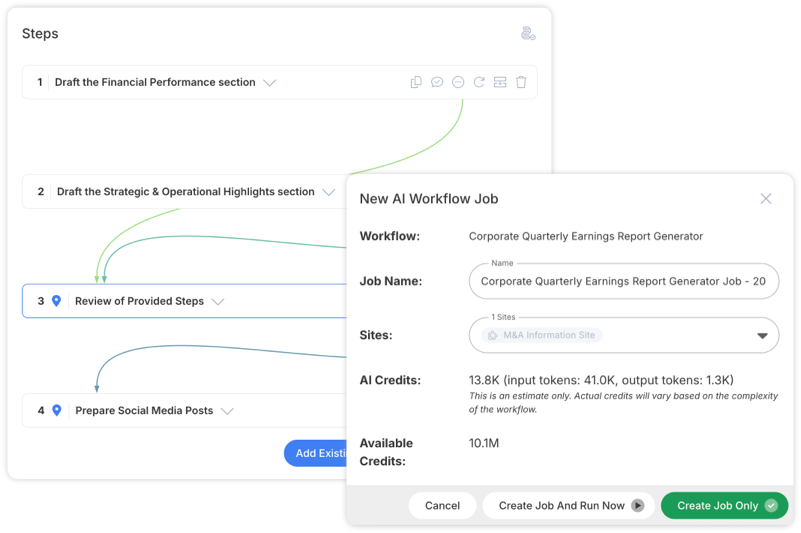
Reorder, insert, or remove steps with a simple drag-and-drop UI. Visual connectors instantly update to show data flow, so even intricate workflows stay easy to read and maintain.

Site Selection

Scope a workflow to one or more Clear Ideas Sites so it pulls only the approved documents that you authorize. The same AI Workflow can roll out across multiple sites while respecting local context.

Output Templates

Include any step in output or use the output template to merge results into a final deliverable.

Visual Drag-and-Drop Workflow Designer
The visual builder opens automation to everyone in the organization, no coding required. As you drag each step into place, live connectors reveal how data flows.
Iterative AI Workflow Building
Use interim outputs to refine your workflow. Automatic benchmarking provides a factual foundation and scores every output on factual accuracy, readability, and engagement.
Repeatable Content and Analysis
Teams that adopt Clear Ideas move from reactive firefighting to proactive content and insight production. Daily blog posts, weekly performance summaries, or fully customized client reports arrive on schedule and in a repeatable, auditable format.
By turning manual tasks into dependable AI workflows, Clear Ideas powers consistent repeatable results at any scale.
AI Workflow Features
Multi-Step AI Workflows
Chain any number of AI-powered steps into a single automated pipeline. Each step can reference the structured output of previous steps, enabling complex reasoning and multi-stage content generation.
Drag-and-Drop Step Management
Reorder, insert, or remove steps with a simple drag-and-drop UI. Visual connectors instantly update to show data flow, so even intricate workflows stay easy to read and maintain.
Smart Variable Management
Define reusable variables once and inject them anywhere—prompts, templates, or loop logic—without repetition. Overrides at run-time let the same workflow adapt to different sites, audiences, or data sets.
Loop & Conditional Logic
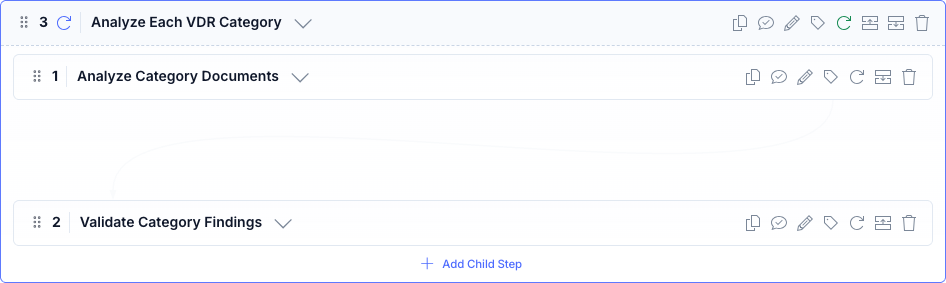
Iterate over lists, tables, or paginated results with optional break conditions and index tracking. Conditional branches let workflows react dynamically to content, ensuring the right path is followed every time.
AI Workflow Step Loop

Loop & Conditional Logic

Iterate over lines, or JSON code from prior steps or variables. Apply conditional logic and let workflows react dynamically to content.

Variables in Prompts

Loop variables in your prompt will be populated when the workflow is run. If the loop is based on an array of JSON object, you can access any property of the object in your prompt.

AI Model Flexibility
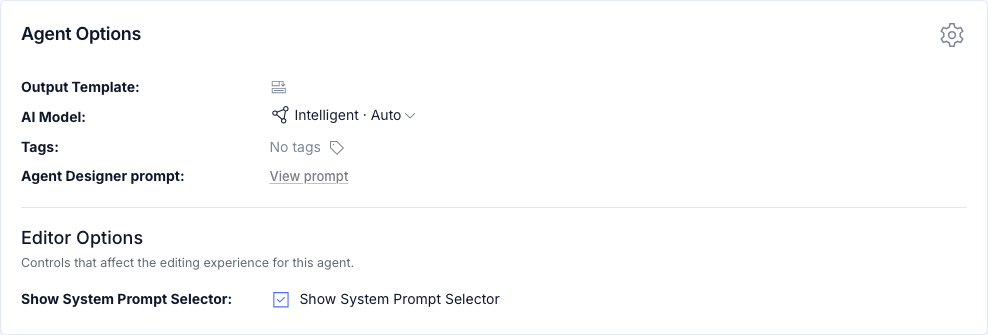
Select the optimal model—fast chat, advanced reasoning, or let Clear Ideas auto-pick based on task complexity and cost targets. Mixing models lets you balance speed, quality, and budget.
Human Approval Checkpoints
Add explicit Human Approval steps to pause execution, request approvals or structured answers, and resume automatically after submission. This gives teams control points without breaking automation.
Cost & Token Estimation
Preview best- and worst-case token usage and credit spend before you hit “Run.” Transparent estimates help teams stay on budget and choose the most efficient model.
Intelligent Benchmarking & Analytics
Automatically score outputs on readability, factual consistency, and engagement using custom or default benchmark prompts. Historical charts surface trends so you can prove improvement over time.
AI Workflow Benchmarking

Dimensional Scoring

The dashboard provides a comprehensive view of an AI Workflow's content across multiple dimensions, including readability, complexity, repetition, clarity, and tone.

Scoring Dashboard

The dashboard provides a comprehensive view of an AI Workflow's content, including overall score and dimensions that are strong or weak.

Actionable Feedback

The dashboard provides actionable feedback on the AI Workflow, allowing you to improve prompts within the AI Workflow.

Output Template Control
Merge AI results into reusable templates to generate perfectly formatted reports, briefs, or knowledge-base articles. You decide exactly which steps feed the final deliverable and in what layout.
Structured JSON Output
Workflows can output structured JSON data for integration with downstream systems or further processing. Define JSON schemas, extract specific data points, and chain structured outputs between workflow steps for complex data transformations.
Automated Scheduling
Run any workflow on flexible schedules—hourly (at specified minute), daily (at specified time), weekly (specific days and times), or monthly (specific dates or expressions like "first Monday"). Ideal for routine content refreshes, compliance checks, executive reports, or chaining with Web Import for automated analysis of external content changes.
Upload-Triggered Extraction Workflows
Run workflows automatically on upload using centralized Extraction Workflows rules configured at the site or folder level. Map upload trigger fields into workflow variables, execute against extracted text or file references, and persist structured metadata back to files for downstream use.
Job Duplication & OutputTemplates
Clone an existing job with one click, tweak inputs, and launch—no need to rebuild from scratch. Output templates can standardize best practices across teams and cut ramp-up time for new users.
Validation & Error Checking
Pre-flight checks flag undefined variables, missing files, or circular references before execution starts. Early detection prevents failed runs and preserves both time and credits.
Error Handling & Recovery
Granular retry rules, timeouts, and fallback branches keep long workflows resilient. If a step fails, you can resume from the last good checkpoint instead of starting over.
Step Output Access
Inspect, download, or reuse the output of any individual step without rerunning the whole job. Developers and analysts can tap intermediate results for debugging or ad-hoc analysis.
Site-Specific Integration
Scope a workflow to one or more Clear Ideas Sites so it pulls only the approved documents that you authorize. The same AI Workflow can roll out across multiple sites while respecting local context.
Security That Grows With You
Strong encryption, detailed audit logs, and governance tooling designed for growing teams—not just large enterprises.
Two Ways to Create Workflows
Start from a polished sample with Build From Document, or start from plain language with Describe With AI. Both paths generate repeatable workflow drafts that you can refine in the visual editor.
Email Notifications
Receive branded email alerts when long-running jobs complete or when they need attention. Each message contains direct links to results or troubleshooting views.

Move from Trial to Production

Use the free trial to validate outcomes, compare platform fit, then involve sales for implementation and governance requirements.

Frequently Asked Questions
How do AI Workflows differ from single AI Chat queries?

AI Workflows orchestrate multiple AI steps in sequence, with each step building on previous outputs. Unlike single chat queries that produce one-off responses, workflows create repeatable, auditable pipelines for complex tasks like document generation, multi-step analysis, or automated reporting. Variables, loops, and conditional logic enable sophisticated automation that maintains consistency across runs.

Can I schedule workflows to run automatically?

Yes, workflows support hourly, daily, weekly, and monthly schedules. Perfect for routine reporting, compliance checks, or monitoring tasks. Combine scheduled workflows with Content Automation to automatically process imported competitor websites or regulatory sources—intelligence delivered on your schedule without manual intervention.

Can workflows run automatically when files are uploaded?

Yes, workflows can run on upload through centralized Extraction Workflows settings. You can define site-wide and folder-specific rules, map upload fields to workflow variables, and automatically save extracted structured metadata to each file for search and automation.

How are AI credits calculated for workflows?

Workflows consume AI credits based on total tokens processed across all steps (input context + generated output) multiplied by the model rates used. The workflow builder shows estimated credit cost before execution. Different models have different rates—advanced reasoning models cost more than standard chat models. Monitor credit usage in real-time and set budgets to control costs.

Can workflows access data from multiple sites?

Yes, scope workflows to one or multiple Clear Ideas sites. The workflow retrieves only from authorized sites respecting all permission controls. This enables cross-site analysis (comparing board packets across subsidiaries) while maintaining site-level security boundaries. External users can only run workflows scoped to sites they have access to.

What happens if a workflow step fails?

Granular error handling with retry rules, timeouts, and fallback branches keeps workflows resilient. If a step fails, resume from the last good checkpoint instead of restarting.

Can I export workflow results?

Yes, export final outputs and intermediate step results in multiple formats. Save results directly to your sites as permanent records, download as files for offline use, or copy to clipboard for pasting elsewhere. Output templates can format results as polished reports, briefs, or structured data automatically.

How do Build From Document and Describe With AI differ?

Build From Document reverse-engineers an existing finished output into a reusable workflow. Describe With AI creates a workflow from a plain-language prompt when you do not have a source document. Both can be refined in the same visual editor and run with repeatable, auditable controls.

Can I use variables in workflows?

Yes, variables enable dynamic, reusable workflows. Define variables for document names, dates, financial figures, or any changing data. Each workflow execution can use different variable values while maintaining the same logic. Variables pass data between steps, enabling complex multi-step processing with full context awareness.

What quality controls exist for workflow outputs?

Automated Quality Benchmarking evaluates outputs on readability, factual accuracy, clarity, tone, and engagement. Set quality thresholds and workflows automatically retry with different models or prompts if benchmarks aren't met. Track quality scores over time to optimize workflow effectiveness and maintain consistent output standards.

Can workflows generate structured data like JSON?

Yes, workflows can output structured JSON for API integration, database loading, or programmatic processing. Define JSON schemas and the workflow ensures outputs conform to your structure. Perfect for extracting structured data from unstructured documents, generating API payloads, or creating machine-readable reports.

Ready to get started?
Share sensitive information securely with clients, auditors, and partners. Then turn approved content into cited answers, repeatable workflows, and measurable engagement.
Start Free
No credit card required
Book a Demo
Need help?
Get personalized assistance
Speak with our sales team to find the perfect plan for your organization.
Technical support & resources
Access our comprehensive support center, documentation, and help guides.