Your team creates a pitch deck. Someone edits it. Someone else saves a "final" version. Then there are revisions to the final. Then a version specifically for the board meeting. Within a week, your file storage looks like this:
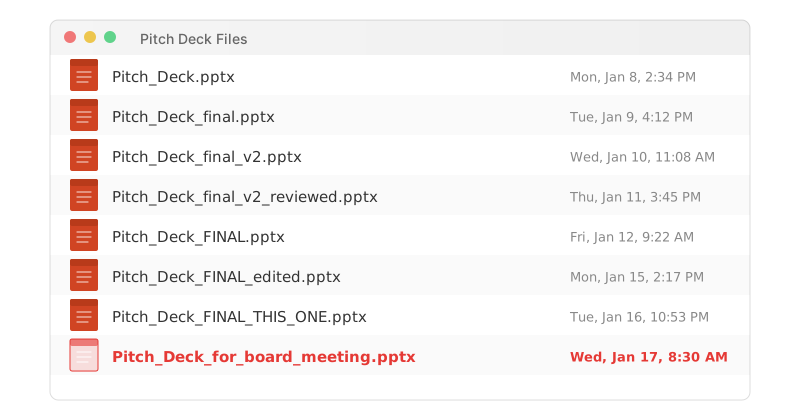
This isn't an edge case. It's the default outcome when teams use file storage platforms as their primary way to manage business documents. Google Drive, SharePoint, Dropbox, Box—these tools are excellent at what they were designed for: letting teams collaborate on files internally. But they were never designed to serve as your system of record, and the difference matters more than most organizations realize.
What Is a System of Record?
A system of record is the authoritative source for a specific set of data. It's where you go when you need the definitive, approved version of something—not a draft, not an interim edit, not someone's working copy.
For structured data, this concept is well understood. Your accounting system is the system of record for financial transactions. Your CRM is the system of record for customer relationships. Nobody would suggest using a shared spreadsheet as the definitive source for either.
But for unstructured data—documents, presentations, reports, contracts—most organizations have no system of record at all. They have file storage. And file storage doesn't solve the same problem.
A true system of record for unstructured data has specific characteristics:
- Immutability: Finalized documents are locked. They can't be accidentally edited, overwritten, or deleted.
- Authority: It's clear which version is the approved, authoritative one—not just the most recently modified.
- Audit trails: Every access, every change, every finalization is logged and traceable.
- Controlled access: Permissions are granular and role-based, not just "anyone with the link."
File storage platforms offer some of these capabilities in limited form (version history, basic sharing controls), but they weren't architected around them. The result is a fundamental mismatch between what organizations need and what file storage provides.
The Version Chaos Problem
Look at that file list again. Which one is the correct pitch deck? The one named "FINAL"? The one named "FINAL_THIS_ONE"? The one created most recently? Version history might tell you what changed, but it won't tell you which version was actually approved and sent to the board.
This version chaos creates three cascading problems:
Teams waste time on archaeology. Instead of doing productive work, people spend time asking "which version is current?" or comparing timestamps to guess which file is the latest. This friction is invisible in any productivity metric, but it accumulates across every team member, every day.
Mistakes reach stakeholders. When multiple versions exist in a shared folder, someone eventually sends the wrong one. The draft instead of the final. Last quarter's numbers instead of this quarter's. The version before legal review instead of after. These aren't hypothetical risks—they're the everyday reality of managing documents through file storage.
Institutional knowledge stays locked in people's heads. The knowledge of which version is "the real one" lives in someone's memory, not in the system. When that person is on vacation, changes roles, or leaves the company, the institutional knowledge goes with them.
External Partners Need Authoritative Documents
The version chaos problem is manageable (if inefficient) when it's limited to internal teams. People can walk over to a colleague's desk or send a Slack message to confirm which file is current.
But when external partners are involved—clients, auditors, consultants, board members—the stakes change entirely.
These stakeholders need finalized, authoritative documents. They need confidence that what they're reviewing is the approved version, not an interim draft. And they need professional infrastructure that reflects the seriousness of the relationship.
File storage can't tell Pitch_Deck_draft.docx from the version you actually approved. There's no mechanism for finalization, no way to designate a document as "this is the authoritative version," no distinction between working copies and approved deliverables.
The result is awkward at best and damaging at worst. Sending a client a link to a shared folder full of draft iterations undermines your professionalism. Sharing sensitive documents through file storage where business and personal files live side-by-side introduces unnecessary risk.
Professional Relationships Need Professional Infrastructure
There's another dimension to this problem that often goes unexamined: the infrastructure itself sends a message about your organization.
When you share documents with external partners through consumer file storage, several things happen:
- Partners access your documents through their personal accounts, blurring professional and personal boundaries
- You have limited visibility into who accessed what and when
- Document watermarking, if available at all, is an afterthought rather than a core capability
- Audit trails are basic and difficult to present to compliance teams
- Permissions are coarse—you can share a folder or a file, but granular control is limited
For regulated industries, client-facing professional services, or any scenario involving sensitive business data, this level of infrastructure simply isn't adequate. Organizations that take external collaboration seriously need purpose-built tools that match the professionalism of the relationship.
Deterministic AI Needs Your Source of Truth
There's a newer dimension to the system of record problem: AI.
Organizations increasingly want to use AI to analyze their documents—generating summaries, extracting insights, identifying risks, automating reporting. But AI's outputs are only as good as its inputs. Feed AI version chaos, and you get unreliable results.
In a folder full of drafts and finals, your AI can't tell which document is correct, so it uses them all. The result is analysis that blends approved figures with draft numbers, mixes outdated projections with current ones, and produces outputs that look authoritative but aren't grounded in verified data.
Deterministic AI workflows require an immutable system of record. When every AI analysis draws from the same verified, finalized data, the outputs become repeatable and defensible. Run the same workflow next month and you can compare results on equal footing, because the methodology and the data governance are both consistent.
This isn't a theoretical concern. Organizations building AI workflow automation are discovering that data quality and governance are prerequisites, not afterthoughts. The AI is the easy part; establishing a trustworthy data foundation is the real work.
Building Your System of Record
The shift from file storage to a system of record doesn't require replacing everything at once. It starts with recognizing that certain documents—the ones shared externally, the ones that drive decisions, the ones that feed AI—need to be managed differently than working files.
Clear Ideas is purpose-built for this transition. Documents are finalized into immutable, authoritative versions that become your single source of truth. Everyone—internal teams, external partners, and AI—works from the same verified data. The result is:
- No version confusion: The system distinguishes between working drafts and finalized documents
- Professional external collaboration: Purpose-built infrastructure for clients, auditors, and partners with granular permissions, watermarking, and complete audit trails
- Reliable AI outputs: Deterministic workflows grounded in verified data that produce consistent, defensible results
- Institutional knowledge preservation: The system of record captures what's authoritative, not individual memory
File storage remains valuable for what it does well—internal collaboration on work in progress. But for the documents that matter most, the ones your external partners rely on and your AI analyzes, a system of record is the infrastructure your organization needs.
Ready to move beyond file storage? Start free with Clear Ideas and build your system of record today.